An EFCA Small Church Specific Resource

In July 2021, Kevin Kompelien, president of the EFCA delivered a sermon at First Evangelical Free Church in St Louis centered around the values of the EFCA. This is an edited version of that video sermon that I used at First Evangelical Free Church in Brooklyn, NY in July 2022. I removed some of the specifics to the particular church (First Free St Louis) but made it clear it was delivered in that specific context. I placed the “Who is the EFCA” video at the end rather than where it was originally, before the sermon. The video length is 37 minutes and I think it could be showed at many small EFCA churches as is with out any further video editing.

The values covered in the sermon and place on the screen are as follows. These could be printed in a bulletin or handout for churches (like mine) that do that sort of thing.

  • Word: Know and obey God’s authoritative scriptures
  • Abide: Prayerful dependence on Jesus in the power of the Holy Spirit
  • Gospel: Centrality of the transforming work of Christ
  • Mission: Great Commandment and Great Commission disciplemaking among all people
  • Community: Priesthood of all believers in appropriate interdependence
  • Unity: In essentials; unity, in the rest; charity.

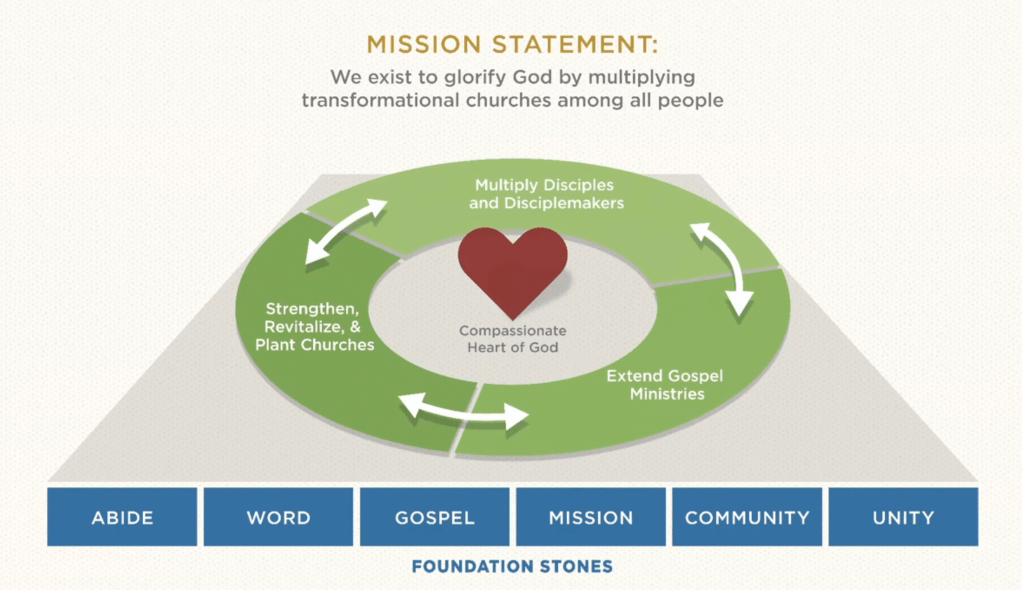
He has a graphic displaying the EFCA Mission Statement: We exist to glorify God by multiplying transformational churches among all people. The graphic has the values as the foundational stones at the bottom and a relationship between discipleship, evangelism/expansion, and strengthening/renewing that looks like this…

Mission and Values

The video as I edited it can be streamed on Youtube here: https://youtu.be/9Kh21HrA_ww


and can be downloaded for offline editing and playing on a desktop computer from Dropbox here:

https://www.dropbox.com/s/b55uctoatoxh0g6/2022%2007%2003%20Sermon%20Kevin%20Kompelien.mp4?dl=0

The original can be streamed from First Free St Louis’ Youtube channel here: https://www.youtube.com/watch?v=vWYtQ9FOAVE

The scripture Kevin reads through is: Mark 1:1-8
The benediction I plan to use is: Isaiah 52:6-10
It would be great to have a suggested Call to Worship or any other appropriate liturgical ideas (including song selection).

June 2022 – Pentecost Plus

Week 23 – Acts 2:1-12 – June 5 (Pentecost) – Here I Am
Scripture Reading: Acts 2:1-12
Benediction: Number 6:24-26
Worship Lead: Joe C

Week 24 – Acts 2:12 – 24  – June 12 – Spirit Poured Out
Scripture Reading: Acts 2:12-24
Benediction: Isa 40:1-5
Worship Lead: Joe M

Week 25 – Acts 2:24 – 40  – June 19 (Father’s Day) – Not Abandoned
Scripture Reading: Acts 2:24-40
Benediction: 1 Cor 15:20-26
Worship Lead: Joe C

Week 26 – Acts 2:40-47 – June 26 – Everything In Common
Scripture Reading: Acts 2:40-47
Benediction: Eph 6:23-24
Worship Lead: Jackie & Maricris

New Member Class At First Free

Updated October 8, 2024

Below are the new member class outline and resources for the classes that lead toward applying for membership at First Evangelical Free Church in Brooklyn, NY.

Course Outline:

  • Youtube Videos for class to watch before end of classes:
  • How to Become a Member at First Evangelical Free Church
    • Step 1: Watch the three sermons covering the foundations, the heart, and the theology of church membership. (Links above.)
    • Step 2: Download the church’s statement of faith or get a physical copy from the church  and read through it carefully, note any questions you may have or anything you don’t completely understand.  It’s common to have some questions for clarification or to not understand the document entirely since it is a very densely packed statement of beliefs.
    • Step 3: Sign up for the next New Member Class by contacting the church office.
    • Step 4: Attend the New Member Class and complete the short reading assignment, I Am A Church Member. If you would like to listen to the audio version of the book, contact the church office.  You will receive a physical copy of the book in the first New Member Class.
    • Step 5: Complete the Membership Application Form. This form includes contact information, your past church membership information and a short version of your personal testimony of faith.
    • Step 6: After the completion of the class, schedule and complete an Elder Interview with one of the church Elders.  After this meeting the Elder will discuss your application with the church Elder board. If they have any questions or concerns they will reach out to address them, but this would be from an unusual circumstance.  Once they are confident in your application, they will bring your name as a recommendation to the next Member meeting and the members will vote on your membership request.  If approved, your membership will be official and you will be formally accepted as a full member at the next church member meeting.

Seven Days and Seven Hundred Years – An Advent Hymn Story

About seven hundred years before the birth of Jesus, Isaiah spoke seven words of the messiah to come. About seven hundred years after the birth of Jesus, Christians gathered to remember the event with seven prayers prompted by Isaiah’s seven prophesies. These seven prayers recited on the seven days leading up to their Christmas worship celebration was a part of their Advent celebration. Now we are almost three times seven hundred years from the glorious birth of Jesus and one of our Christmas hymns reflects these prayers as they developed into one song over the past 1400 years. See if you can guess which one as we listen into these ancient prophesies and the early Christian prayers they inspired.

The first word from Isaiah was concerning the spirit of wisdom. We read in Isaiah chapter 11: “The spirit of the Lord shall rest on him, the spirit of wisdom and understanding, the spirit of counsel and might, the spirit of knowledge and the fear of the Lord. His delight shall be in the fear of the Lord.” Isaiah 11:2-3

So seven days before Christmas, many hundred years ago early Christians would pray:
O Wisdom, coming forth from the mouth of the Most High,
reaching from one end to the other,
mightily and sweetly ordering all things:
Come and teach us the way of prudence.

Second Isaiah speaks of the Messiah’s rule and dominion: “[…] but with righteousness he shall judge the poor, and decide with equity for the meek of the earth; he shall strike the earth with the rod of his mouth, and with the breath of his lips he shall kill the wicked. Righteousness shall be the belt around his waist, and faithfulness the belt around his loins.” Isaiah 11:4-5 Isaiah also declared “For the Lord is our judge, the Lord is our ruler, the Lord is our king; he will save us.” Isaiah 33:22. Later he proclaimed, “
The Lord looked and was displeased that there was no justice. He saw that there was no one, he was appalled that there was no one to intervene; so his own arm achieved salvation for him, and his own righteousness sustained him. He put on righteousness as his breastplate, and the helmet of salvation on his head;” Isaiah 59:15b-17a

In chapels and churches a thousand years before the age of Enlightenment and six days before celebrating Christ’s birth, young and old Christians would recite together:
O Adonai, and leader of the House of Israel,
who appeared to Moses in the fire of the burning bush
and gave him the law on Sinai:
Come and redeem us with an outstretched arm.

Third Isaiah refers to the Messiah as both the shoot and the root of Jesse. We read “A shoot shall come out from the stock of Jesse, and a branch shall grow out of his roots.” Isaiah 11:1
“On that day the root of Jesse shall stand as a signal to the peoples; the nations shall inquire of him, and his dwelling shall be glorious.” Isaiah 11:10

Five days prior to xmas, prayers would remind:
O Root of Jesse, standing as a sign among the peoples;
before you kings will shut their mouths,
to you the nations will make their prayer:
Come and deliver us, and delay no longer.

Forth the Messiah is understood by Isaiah to be the key of David. “I will place on his shoulder the key of the house of David; he shall open, and no one shall shut; he shall shut, and no one shall open.” Isaiah 22:22
“His authority shall grow continually, and there shall be endless peace for the throne of David and his kingdom. He will establish and uphold it with justice and with righteousness from this time onwards and for evermore.” Isaiah 9:7
“To open the blind eyes, to bring out the prisoners from the prison, and them that sit in darkness out of the prison house.”Isaiah 42:7.

This next prayer raised four days prior to the day of Jesus birth would be called out:
O Key of David and scepter of the House of Israel;
you open and no one can shut;
you shut and no one can open:
Come and lead the prisoners from the prison house,
those who dwell in darkness and the shadow of death.

Fifth Isaiah anticipated a great illumination, and morning light that the Messiah would bring to cancel nights darkness . “The people who walked in darkness have seen a great light; those who lived in a land of deep darkness—on them light has shined.” Isaiah 9:2

Now just three days remain, the anticipation climbing still. A thousand and a half years ago Christian voices spoke out:
O Rising Sun (or O Morning Star)
splendor of light eternal and sun of righteousness:
Come and enlighten those who dwell in darkness and the shadow of death.

Sixth the messiah was known by the prophets to be the king of all the nations. “I will shake all nations, and what is desired by all nations will come, and I will fill this house with glory,’ says the LORD Almighty.” Haggai 2:7
Isaiah had prophesied:
“For a child has been born for us, a son given us; authority rests upon his shoulders; and he is named Wonderful Counsellor, Mighty God, Everlasting Father, Prince of Peace.” Isaiah 9:6
“He shall judge between the nations, and shall arbitrate for many peoples; they shall beat their swords into plough shares, and their spears into pruning-hooks; nation shall not lift up sword against nation, neither shall they learn war anymore.” Isaiah 2:4

On the eve of Christmas eve, the faithful ones of centuries passed would recall:
O King of the nations, and their desire,
the cornerstone making both one:
Come and save the human race,
which you fashioned from clay.

Finally and seventh, Jesus was to be God with Us: Immanuel. “Therefore the Lord himself will give you a sign. Look, the young woman is with child and shall bear a son, and shall name him Immanuel.” Isaiah 7:14

This was prophesied seven hundred years before his birth and seven hundred years after, his disciples would call out on Christmas Eve:
O Emmanuel, our king and our lawgiver,
the hope of the nations and their Savior:
Come and save us, O Lord our God.

For another thousand years these prayers strengthened, changed and grew to become the foundation of a song we now sing. We can thank John Mason Neale for his 1861 translation of the 1710 latin text:

Draw nigh, draw nigh, Emmanuel,
And ransom captive Israel,
That mourns in lonely exile here,
Until the Son of God appear;
Rejoice! rejoice! Emmanuel
Shall be born for thee, O Israel!

Or as would become preferred, opening lines of each stanza: (hymnary.org direct link)

  1. O come, O come, Emmanuel,
  2. O come, O Wisdom from on high
  3. O come, O come, great Lord of might,
  4. O come, O Branch of Jesse’s stem,
  5. O come, O Key of David, come
  6. O come, O Bright and Morning Star,
  7. O come, O King of nations, bind

Mark Young, president of Denver Seminary recently wrote:
We’re all waiting, longing, yearning.That’s why we sing,“O come, O come.” It’s a cry of anticipation, a plea for someone to make everything that’s wrong in the world right, and everything that’s broken in the world, whole, and everything that’s ugly in the world beautiful.We’re not at peace with the way the world is and we instinctively know that no politician, no sage, no warrior, and no earthly ruler can fix it. So, we cry out,“O come, O King of Nations, come!”

Perhaps our prayer can be the current seventh stanza of this great hymn:
7 O come, O King of nations, bind
in one the hearts of all mankind.
Bid all our sad divisions cease
and be yourself our King of Peace.

May he be our peace with God, may he bring us peace with our fellow man.

Advent 2021 Series Plans

WW48 – November 28 – Advent 1
Text to be Read & Reader: Luke 2:1-15,
Advent Reading: Isaiah 9:2-7
Worship Leader: Joe M.
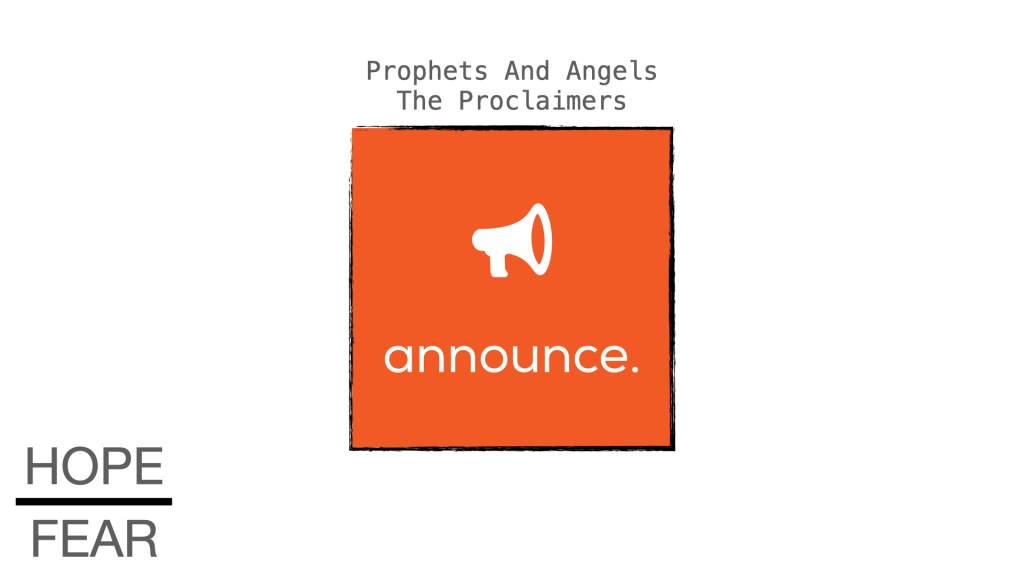
Sermon Title: The Proclaimers: Prophets and Angels
Big Idea (If I know it): (With the Prophets and Angels) We Proclaim the Results of Christ’s Reign (presence & peace) – HOPE over FEAR

WW49 – December 5 – Advent 2
Text to be Read & Reader: Luke 2:8-20, Matt 2:1-8
Advent Reading: ISAIAH 11:1-10
Worship Leader: Maricris & Jackie
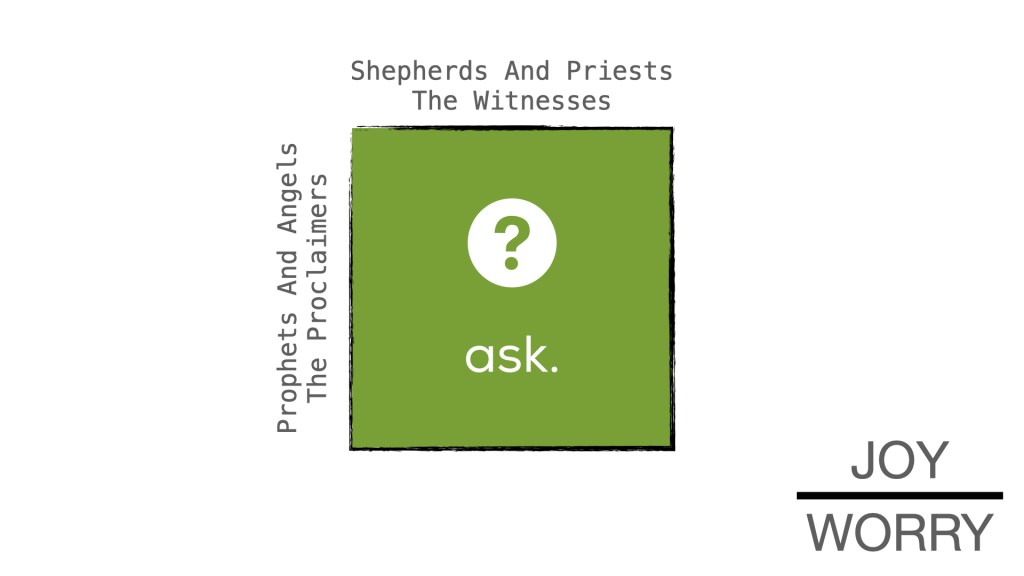
Sermon Title: The Witnesses: Shepherds and Priests
Big Idea (If I know it): Our response to God’s movements follows our kingdom commitments. – JOY over WORRY

WW50 – December 12 – Advent 3
Advent Candle Text: Isaiah 60:1-6
Text to be Read & Reader: Matthew 2:1-15
Worship Leader: Jackie & Maricris
Sermon Title: The Worshipers: Herod and Magi
Big Idea (If I know it): BI: Worshiping God frees us from worshiping ourselves.

WW51 – December 19 – Advent 4
Text to be Read & Reader: Luke 1:46-55, 2:36-38
Advent Candle Text: Isaiah 54:1-8
Worship Leader: Joe Mayer
Sermon Title: The Expectant: Mary and Anna
Big Idea (If I know it): Waiting with God keeps our vision fresh for his work.

WW52 – December 26 – Christmas Celebration
Lessons and Carols?
Worship Leader: Maricris & Jackie

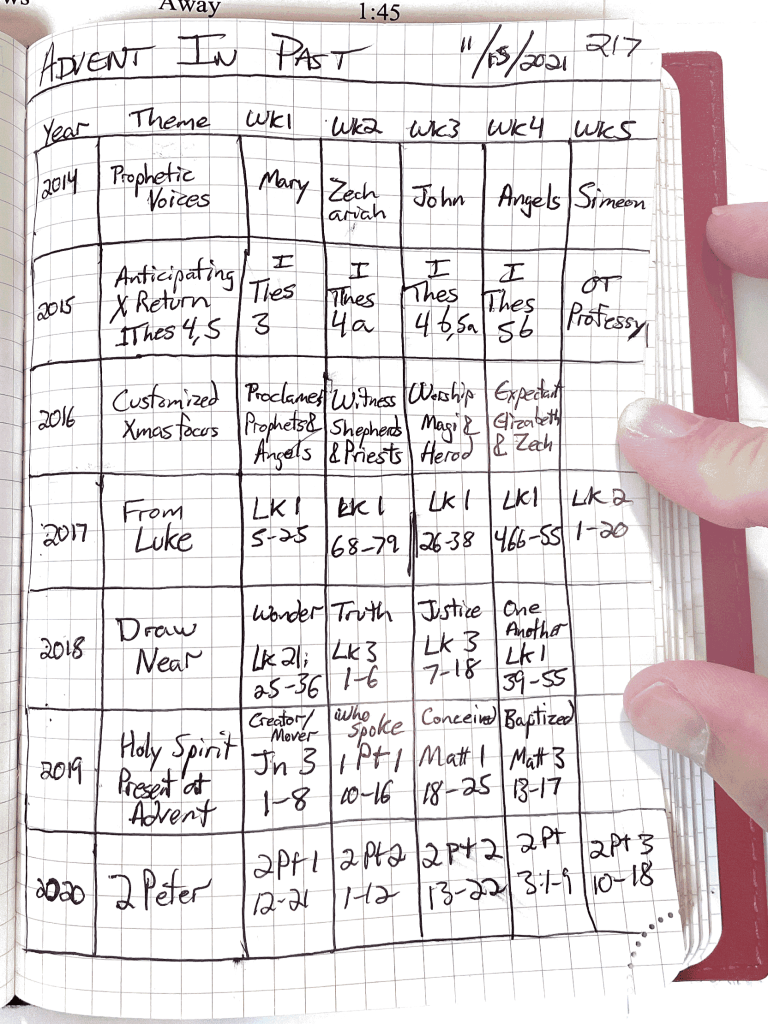
The above is a quick review of what we have done in the past several years. This year would be a “repeat” of 2016 in terms of topics and most of the texts, but the sermons refreshed and probably quite different.

2021 Easter Sermon on 1st Corinthians 15:35-58

Do you enjoy a good mystery? Do you love a puzzle? Or maybe a crossword? Perhaps for you, it’s fixing something that needs repair. I enjoy a well-told story that unfolds hints and clues along the way. I can enjoy an old mystery novel or a movie filled with plot twists, but let’s be honest: Generally we enjoy a mystery or a puzzle for it’s challenge AND for its resolution. The mystery of life and death looms large for us because it is of great importance, but also because there is a mystery for us that remains somewhat unresolved. Today I want to talk about this resolution a bit. 

Last week we discussed the first portion of this chapter in Paul’s letter to the church located in Corinth. In the beginning of chapter 15, Paul argues that Jesus’ resurrection is as important to Christian faith as Jesus’ birth. Another church leader, Basil, wrote a couple hundred years after Paul to a church in modern Turkey. He said, (I paraphrase): [Basil of Alexandra to Sozopolis in Pisidia]

“If Jesus had not been born of Mary, he could not have endured human suffering and be described as truly human.

If Jesus had not actually died, then he could not have conquered death by being resurrected from the dead.”

And the apostle Paul told us last week: Jesus was born of Mary, lived on the earth, he died on the cross, he was placed in the tomb, and on the third day, he rose from the dead. If you missed last Sunday and wonder at all if it is important that Jesus actually did raise from the dead, then please check out last weeks sermon, or better yet, read the first half of this chapter. 

35    But someone will ask, “How are the dead raised? With what kind of body will they come?” 

Ah, aren’t you curious? Don’t you wonder what it will be like? What life after death will really entail? This isn’t just the subject of a after-school TV show? (Remember when TV shows were shown at specific times of the day?) Anyways, this fascination, this mystery, fills us, because we all know what it is like to live, at least we think we should. Every morning we awake. Yesterday I woke up and just as I expected, I was alive, just like the day before. I woke the same man who dozed off to sleep, only a bit more refreshed. But that won’t always be the case will it. One famous Christian author, Phillip Yancey once had a near death experience: a car accident left him lying on the concrete staring up at an emergency medical technician. The EMT told him plainly the deep wound would likely take his life. He wrote that three questions rang like a piano hammer striking single strings: One, Two, Three. 

“Who do I love? What have I done with my life? (and) Am I ready for whatever is next?” 

– [Philip Yancey, The Question that Never Goes Away, 2013, p 50.]

Last week we dared to ask “is there life after death?” This week, we ask Paul: “how are the dead raised?”

Paul starts with a picture:

36How foolish! What you sow does not come to life unless it dies. 37 When you sow, you do not plant the body that will be, but just a seed, perhaps of wheat or of something else. 38 But God gives it a body as he has determined, and to each kind of seed he gives its own body. 

This is a bulb <<HOLD UP A BULB>>. It is pretty large, but from it grows a relatively small but beautiful tulip. But only if I give it up and plant it. Only if I bury it and allow it to perish. This is an acorn <<HOLD UP AN ACORN>>. It is smaller, but you might know, that God has determined that this little seed might, should it be buried, should it crack, decay a bit, break open and give up being a seed, this seed might become a mighty oak. It is a great image Paul uses. Indeed, it’s almost like God created things so that in every planting and harvest cycle we humans would watch again the great mystery that Jesus spoke of. Remember him saying: “unless a kernel of wheat falls to the ground and dies, it remains only a single seed. But if it dies, it produces many seeds?” 

A pastor friend wrote: “You can count all the apples on a tree, but who can count the apples in a seed?” 

  • (Mike Syers FB page. Not sure where he got it)

So we see a clue in our mystery. In nature, a seed holds in its tiny form a potential plant or tree or flower. But that plant or tree can only be released if the seed vanishes.

39 Not all flesh is the same: (Paul continues) People have one kind of flesh, animals have another, birds another and fish another. 40 There are also heavenly bodies and there are earthly bodies; but the splendor of the heavenly bodies is one kind, and the splendor of the earthly bodies is another. 41 The sun has one kind of splendor, the moon another and the stars another; and star differs from star in splendor.

Our second clue in our detective work comes from nature also. Paul’s point here is a bit obscured if we get to close in. Take a step back to see the picture he’s painting. Earthly creatures differ from each other in obvious and significant ways. Much bigger ways than say you and I differ. This is also true of the heavenly bodies. Stars differ from other stars a bit, but they differ from moons a great deal more. My flesh is different from a salmon, and Pluto is different from a comet. BUT I am in a totally different category of different from the burning hydrogen furnace of a star. The earthly creatures are TOTALLY DIFFERENT from the heavens and their cosmic inhabitants.

Perhaps Paul is alluding to a portion of the exiled prophet Daniel who, speaking for God, wrote: (Daniel 12:2-3)

  • But at that time your people—everyone whose name is found written in the book—will be delivered. 2 Multitudes who sleep in the dust of the earth will awake: some to everlasting life, others to shame and everlasting contempt. 3 Those who are wise will shine like the brightness of the heavens, and those who lead many to righteousness, like the stars for ever and ever. 

Ahhh, our second clue: earthly creatures don’t belong in the heavens.

So here Paul reaffirms our questioning hearts saying…

1Cor. 15:42    So will it be with the resurrection of the dead. The body that is sown is perishable, it is raised imperishable; 43 it is sown in dishonor, it is raised in glory; it is sown in weakness, it is raised in power; 44 it is sown a natural body, it is raised a spiritual body.  If there is a natural body, there is also a spiritual body.

We are alive now, we will perish. We spoil. Paul says my body is sown in dishonor, in weakness. He’s right you know. If you’ve been near to our loved ones as death closes in, it is truly undignified, tragically vulnerable. But the contrast is like difference between the passing old woman and the beautiful moon, the injured, coughing, sickly boy and the glory of Saturn adorned with celestial halos. 

it is sown in dishonor, it is raised in glory; it is sown in weakness, it is raised in power; 

The body that is sown is perishable, it is raised imperishable; 

it is sown a natural body, it is raised a spiritual body. 

What was merely earthly has become heavenly.

Our final clue before we resolve our mystery:

45 So it is written: “The first man Adam became a living being”; the last Adam, a life-giving spirit. 46 The spiritual did not come first, but the natural, and after that the spiritual. 47 The first man was of the dust of the earth; the second man is of heaven. 48 As was the earthly man, so are those who are of the earth; and as is the heavenly man, so also are those who are of heaven. 49 And just as we have borne the image of the earthly man, so shall we bear the image of the heavenly man.

There is the trail to follow, back down from my father and mother to their fathers and mothers, their grandparents, ancestors named and many more forgotten. The person I am, reflecting now the sum of their movements, choices, and fates, importantly back all the way to Adam, the first man, Eve, the first woman. Created on the earth, from the dust, their natural life replicated through the generations of children born in their image, of the same kind, to this day. And here we are, daughters and sons of Adam.

But then who is the last Adam? Last week we saw Paul making the connection between Adam as the first man who had death to question and Jesus as the first man who had resurrection to reply. So here the last Adam is Jesus who Paul calls also “a life-giving spirit.” There are some interesting paths here to explore you Bible geeks out there. What about Adam’s first breath and Jesus’ last breath are implied here? Does “last” mean “ultimate” or “finishing” since it doesn’t seem to mean chronologically last? Is Jesus the “second man” as in the replacement first-born? I see some trail heads over by the phrase “life-giving spirit” also…

But we must press into Paul’s bigger picture here to find our goal. Earthly humans Adam and Eve came first and so we are all born as an earthly images of them. But Jesus came later as a heavenly man, and follow Paul’s argument, specifically Jesus who is resurrected from the dead is the heavenly man. So he concludes And just as we have borne the image of the earthly man, so shall we bear the image of the heavenly man.

This is glory, the power, he spoke of earlier. The imperishable nature of the resurrected body. Right now you bear the image of God that he created Adam and Eve to bear, but one day, sister, one day brother, you will bear the image of Christ. 

So clue 1: Seeds perish like human bodies, but their death begins a new, more full, more complete life. One might even say, their actual intended life is realized after they are buried.

Clue 2: Earth bound life is wonderfully diverse and cosmic bodies dance and shine in their own amazing ways, but earthly bodies don’t belong in the same category as the stars. Neither does the natural mortal body compare to the heavenly or spiritual immortal body to come. 

Clue 3: As humans, like Adam, we all face the mystery and terror of death. But Jesus, risen from the dead, is a final “Adam” and reveals a heavenly answer to an earthly problem: a spiritual and material body that by God’s fiat and design belongs in heavenly categories while still birthed from an earthly seed.

Our Conclusion?:

1Cor. 15:50    I declare to you, brothers and sisters, that flesh and blood cannot inherit the kingdom of God, nor does the perishable inherit the imperishable. 

53 For the perishable must clothe itself with the imperishable, and the mortal with immortality. 54 When the perishable has been clothed with the imperishable, and the mortal with immortality, then the saying that is written will come true: “Death has been swallowed up in victory.” 

1Cor. 15:55    “Where, O death, is your victory?

Where, O death, is your sting?” 

<<PAUSE>>

So we see in the mystery a resolution if we will have it. Our mortality from Adam and Eve, from our frail humanity, must be clothed by Jesus’ immortality. Just as God fashioned clothing to cover Adam and Eve’s shame, so to he fashioned salvation to cover our evil, to forgive my wickedness and our sin.

1Cor. 15:56    The sting of death is sin, and the power of sin is the law. 57 But thanks be to God! He gives us the victory through our Lord Jesus Christ.

1Cor. 15:58    Therefore, my dear brothers and sisters, stand firm. Let nothing move you. Always give yourselves fully to the work of the Lord, because you know that your labor in the Lord is not in vain.

[CLOSING ILL: LAX terminal line]

In my previous career, over two decades ago, I arrived at Los Angeles’ LAX airport. I made my way to the International terminal with tickets to fly to Manila, the capital of the Philippines. As I followed sign after sign from the domestic flight area to the international terminal I found myself in a line dozens and dozens of people long. It looked like it was a line to get into the international terminal. I thought it was an odd place for a line, but many people where cueing up behind me and waiting patiently. But the line wasn’t moving, and I didn’t have much time. After waiting twenty minutes with no progress, the mystery of the purpose of the line, or the realization that I might miss my flight caused me to get out of line, risking my place to see what was at the front of the line. Ten people. Twenty people. Passing thirty people, then forty, then more… Finally I came upon the front of “the line”. A tourist group of about 15 people had stopped against a wall to collect themselves and organize their bags. There was no purpose of the line. It wasn’t a check point or a narrow opening or anything. It was just 15 or 20 people standing in such an organized manor that a line had formed behind them assuming they were waiting purposefully. 

Brothers and sisters, we are not waiting as the world waits. We are not passing time from birth to death as if our atoms were just another cluster of material. I made my flight because I stepped out of line to resolve the mysterious delay. Today we resolve the mysterious work of God in salvation. Would you step out in faith and trust Jesus? Would you believe his words that if you give up your life, he will save it? Would you trust him who asks you to give your entire life knowing that he gave his entire life?

[CLOSING PRAYER]

Luke 4:1-11 – Jesus’ Temptation in Luke

Sermon delivered February 14, 2021.

BI: Jesus reminds us the Holy Spirit will use God’s word to strengthen us.

INTRODUCTION

I was outside the meeting hall, talking with Pastor Bill Sweeting and Roy Larsen, perhaps Pastor Zach Guyten when the President approached.  Now, before you get excited, it was the new President of Trinity International University, our denominations affiliated school.  We were scheduled to formally vote, all the church delegates, confirming his placement in this important role.  What I watched quietly at that door was truly a moment that revealed more about this guys character than any speech he was supposed to make.  You see as the new President, Nicholas Perrin did not have the right to vote any of the other maters being brought to the floor.  So he lacked the delegate lanyard that Bill and Zach and I had around our necks.  Three Trinity students, maybe sixty years between them, had been placed as sentries at the door of the auditorium.  No one with out a delegate lanyard was to be allowed in.  As the incoming President, these three students didn’t know Dr. Perrin from anybody, so they told him politely, that he was not allowed in.  Whatever, emotion, embarrassment, feelings of frustration as he was due to speak before the convention in just minutes, what I saw was gentle respect and kindness.  He simply said, “I’m sorry. I understand.”  And he left.  I know he made his way in through another entrance without trouble because he was there to do his presentation just minutes later.  But that moment of confrontation, this little temptation to exert his status, his position, his reputation which he handled so gracefully and humbly may have only been witnessed by two or three of us who were paying close attention. 

I know you are facing emotions, motivations, temptations that are both completely new and novel, but also familiar at the same time.  If you are not, then I am, and this sermon will be merely to encourage me. But I think we are together in this season. And today:

Jesus reminds us the Holy Spirit will use God’s word to strengthen us even in our temptations.

BODY

Luke, in his Gospel, is establishing an account for those who would love God and seek his path. The story of Jesus began with miracles, angelic prophecies, and people “filled with the Holy Spirit”. Jesus’ first words recorded by Luke are found in chapter two.  A young Jesus addresses his parents and speaks a deep truth about who’s son he really is.  They lost track of Jesus while traveling to Jerusalem and finding him after three days he said…

(Luke 2:49) – “Why were you searching for me?” (he asked.) “Didn’t you know I had to be in my Father’s house?” 

Side note: at the end of Luke’s work, two other Mary’s are asked three days after Jesus’ death, “Why do you search for the living among the dead?” (Lk 24:5)

but here, in Chapter 2, Jesus is found at his father’s house, the temple of God.

In Chapter 3 Jesus is baptized by his cousin John whose ministry had converted tax collectors and soldiers, farmers and fishermen. John prepares them for Jesus saying that he will bring more than water baptism: baptism with the Holy Spirit.  And as Jesus himself is baptized in the Jordan, the Holy Spirit descends on him and a voice from heaven says: “you are my son, whom I love, with you I am well pleased.” (Lk 3:22) 

Jesus begins his ministry aged approximately 30 and Luke inserts his genealogy, “He was the son, so it was thought, of Joseph,” (Lk 3:23)…

So whose son is this Jesus?  This is very much the focus of Luke as we enter Jesus’ formal ministry.  Next week we will hear Jesus’ neighbors exclaim, “Isn’t this Joseph’s son?”

Whose son is he really?

Today our text will probe our hearts with this same question: Whose child are you? Whose child am I?

Jesus will demonstrate for us: As God’s children: the Holy Spirit will use God’s word to strengthen us.

INTRO: Luke 4:1-2

“Jesus, full of the Holy Spirit, left the Jordan and was led by the Spirit into the wilderness, where for forty days he was tempted (or tested) by the devil. He ate nothing during those days, and at the end of them, he was hungry.”

Wait, Pastor, how can Jesus really be tempted? He’s God.  It’s not the same thing as I experience because I am not God!  Didn’t Jesus’ half brother James write: (James 1:13-14) When tempted, no one should say, “God is tempting me.” For God cannot be tempted by evil, nor does he tempt anyone; but each person is tempted when they are dragged away by their own evil desire and enticed.

So if Jesus is God (and he is), then isn’t James saying Jesus can not really be tempted? Here is where it’s important for us to understand the Son of God became human, a human did not become the Son of God. This is critical. A member of Adam’s family did not acquire divine nature or ascend to become God. No. A member of the Trinity descended and became a member of Adam’s family line, a human.  

The author of Hebrews summarized this critical bit of theology in the second chapter of that book: 

(Hebrews 2:14-18) Since the children have flesh and blood, he too shared in their humanity so that by his death he might break the power of him who holds the power of death—that is, the devil— and free those who all their lives were held in slavery by their fear of death. For surely it is not angels he helps, but Abraham’s descendants. For this reason he had to be made like them, fully human in every way, in order that he might become a merciful and faithful high priest in service to God, and that he might make atonement for the sins of the people. Because he himself suffered when he was tempted, he is able to help those who are being tempted.

You can’t kill God, but Jesus “made himself nothing by taking the very nature of a servant, being made in human likeness. And being found in appearance as a man, he humbled himself by becoming obedient to death.” (Philippians 2:7,8)


God can not be tempted by evil, but Jesus “shared in our humanity, fully human in every way… because he suffered when he was tempted, he is able to help those who are being tempted.

So Luke shares that Jesus was in the wilderness being tempted by the Devil during a long and Biblically complete 40 days.  During these 40 days he did not eat, so through temptation and hunger, Jesus is physically and physiologically exhausted…

TEMPTATION 1: Luke 4:3-4

The devil said to him, “If you are the Son of God, tell this stone to become bread.”

Jesus answered, “It is written: ‘Man shall not live on bread alone.’”

Like Israel’s 40 years in the wilderness, being fed manna from God, Jesus hunger could be satisfied by a divine act if he would take this suggestion. But observe the source.  The Devil is not only probing his hunger, but also his identity.  “If you are the Son of God…” prove it. Feed yourself in the wilderness like your Father fed the nation. Show your power man! You don’t have remain hungry. You don’t deserve to be exhausted.  But Jesus in not in a famine, unable to eat. He’s chosen to fast, he’s ben led by the Holy Spirit to the wilderness, and in the rivers of the Jordan, God’s voice confirmed, he is the Son of God. 

Jesus words here, in fact, all his words spoken in these three statements and first thing from his mouth next week are all quoting God’s word, scripture. This quote and his next two are from Deuteronomy. 

First, Jesus trusts his identity and God’s provision and timing because he knows God’s word. This is the way.

Jesus reminds us the Holy Spirit will use God’s word to strengthen us when we need it most.

Christian: We also have hungers and appetites, desires of the flesh, good and God-given, that the devil will exploit to tempt us. We rarely fast, and are always nourished, we feast often and are tempted into gluttony. We are parched for intimacy but are saturated in sexually suggestive songs, advertisements, and entertainment. We are tempted by lusts and cravings corrupted from God’s good gift of tender love and friendship into perverse selfishness. We strive after currency, things, travel, and toys. We are not poor by any standard, certainly not global standards, but we are tempted by idolatry as we grasp and hoard.

But Jesus reminds us our identity. Christian, we are children of God. Giver of all good things. Jesus knew his hunger was both appropriate and the core of the temptation.  Jesus is with you. The Holy Spirit strengthens you with God’s truths about your hurts, wounds, temptations, trials, about your hungers, appetites, and desires. Your Father’s word will guide you. His Holy Spirit can work to bring health and satisfaction that comes from above.  Jesus shows us that the Holy Spirit will use God’s word to strengthen us.

You can stand, Child of God, because we don’t live by bread alone, but by every word that proceeds from the mouth of God.

Second…

TEMPTATION 2: Luke 4:5-8

The devil led him up to a high place and showed him in an instant all the kingdoms of the world. And he said to him, “I will give you all their authority and splendor; it has been given to me, and I can give it to anyone I want to. If you worship me, it will all be yours.”

Jesus answered, “It is written: ‘Worship the Lord your God and serve him only.’”

So supernaturally, drawn into the sky or a high place, the Devil some how displays “all the kingdoms of the world” … in an instant. 

<<FAST, DRAMATIZE THE CAMERA>> 

Not unlike our modern film techniques that zoom impossibly from the atmosphere through clouds, rooftops and into the place of one scene only to pull back into the sky and descend across the earth. The audience is given a divine perspective enabling us to see what the characters in the story couldn’t possibly see. 

Jesus is shown what the Devil claims he has authority over: all the earthly kingdoms, their armies, prisons, merchants, kings and priests.

The devil tells Jesus, “I will give you all their authority and splendor; it has been given to me, and I can give it to anyone I want to.”  From the brutality of war and power through history, we might believe the devil has dominion and authority. It’s alway easy to summarize these historical kingdoms in terms of battles and territory, castles and dungeons, trade routes and diplomatic ties.  But God seems super focused on the relationships, the kinship of humanity. In the iconic Psalm 2 our Bible says: 

(Psalms 2:6-8) “I have installed my king on Zion, my holy mountain.” I will proclaim the LORD’S decree: 

 He said to me, “You are my son; today I have become your father.

 Ask me, and I will make the nations your inheritance, the ends of the earth your possession.

The devil tests Jesus’ relationship with his Father: simply kiss my ring, and I’ll give you way to bypass the cross, a path to “all people” that doesn’t require the pain, suffering, death. “If you worship me, it will all be yours.”

<<PAUSE>>

Quick to the scripture, Jesus responds: “It is written: ‘Worship the Lord your God and serve him only.’”

Earlier in our text, Luke writes that the angel told Mary (Lk 1:33) “[your son] will reign over Jacob’s descendants forever; his kingdom will never end.”

Jesus refuses to take for himself what only should be given him by his true Father. His identity as the scepter of Judah is only given by the only one worthy of worship. He refuses to give the devil the one thing he craves most, to be worshiped in place of God.

Again, Jesus reminds us that the Holy Spirit will use God’s word to strengthen our resolve.

Child of God: We also fight temptations to worship the good things God has for us rather than the good God who gave them to us. Work accolades, Grades at school, a Spouse, our Reputation, Friendships… these and other blessings can become misplaced. The devil can confuse our focus.  

We may not imagine we would ever WORSHIP THE DEVIL! But perhaps we do bow to the deceiver when we “exchange the truth about God for a lie, and worship and served created things rather than the Creator” (Romans 1:25).  We listened to the serpent’s whisper, “you will be like God” (Genesis 3:4). You need to control these things in your life, you need to have power over them. You can’t trust God to continue being good. 

Saint of God, you can bow to the only good God. Jesus trusted his Father in life and in his death. Jesus shows us that placing anything before the one true God, our Father, will actually lead to loosing hold of it.  To gain life, Jesus shows us we can give our lives to God and he will raise us into life with him. Paul wrote that Jesus “disarmed the powers and authorities, he made a public spectacle of them, triumphing over them by the cross.” and that you saint also “died, and your life is now hidden with Christ in God.” (Col 2:20,3:3).

Jesus demonstrated to us that the Holy Spirit uses God’s word to strengthen us, when our will feels weak.

Third… 

TEMPTATION 3: Luke 4:9-12

The devil led him to Jerusalem and had him stand on the highest point of the temple. “If you are the Son of God,” he said, “throw yourself down from here. For it is written: “ ‘He will command his angels concerning you to guard you carefully; they will lift you up in their hands, so that you will not strike your foot against a stone.’”

Jesus answered, “It is said: ‘Do not put the Lord your God to the test.’”

From the wilderness to the heights, now to the temple, Luke places this temptation third and focus’ on the Temple of God.  Again the devil challenges Jesus’ identity: “If you are the Son of God” and turns the tables on Jesus. “For it is written” Satan suggests Jesus needs to prove his trust in God’s Word.  Do you really believe? Then test this scripture… Quoting from Psalm 91… For it is written: Satan recites “ ‘He will command his angels concerning you to guard you carefully; they will lift you up in their hands, so that you will not strike your foot against a stone.’”   <<PAUSE>>

How convenient the devil stops there and doesn’t include the next verse about trampling the cobra.  Maybe too close, too soon. 

The temptation Jesus faces begins with his identity again.  Who’s son are you?  Is this really your Father’s house?  Will your Father really spare your life? If you are his beloved Son, if you are the fulfillment of these “written Words of God”, then you won’t die… even if you jump…

If you are God’s anointed one, surely you won’t have to die.

Again from Deuteronomy, Jesus says, “Do not put the Lord your God to test.”  This passage he quotes from Moses’ sermon is reminding the Israel of the location where God instructed Moses to speak to the rock and God would cause water to flow for them. Instead, Moses strikes the rock with his rod. The temptation to be the focus, the source of this miracle perhaps is one that Moses gave into.  Jesus uses Moses’ words here to face a similar temptation. The “I’ll show you who I am” temptation. 

I’ve never been tempted to jump from a temple roof, but I’ve failed a million times when tempted to show off spiritually, intellectually, with some skill I’m proud of. But Jesus’ temptation isn’t merely for a small bit of pride or applause.  Jesus is taken from the Jordan river and the Father’s blessing to the rugged wilderness in fellowship with the Holy Spirit. As he is tested and pressed, the devil dangles relief from his hunger, quick results and instant authority, then finally fame, glory, perhaps even worship. Jesus looks down upon a crowd, perhaps unaware at their presence above. His ministry will eventually bring him back to this temple with only a small faithful group of followers. Such a different path toward God than the quick dive the devil is offering. 

I should note that Jesus’ reply is not only an intellectual rebuttal. “Do not put the Lord your God to the test.” This is not only Jesus refusing to put his true Father to the test. It is that. But it is also a rebuke to the Devil. “Do not put the Lord your God to test.”  Who is testing our Lord? The Devil. And Jesus rebukes him … and answers him. “Do not put the Lord your God to the test.” 

Sisters, Brothers, you can lean into trusting God without testing him.  His path for us is rarely the easiest way, it is described as the narrow gate, taking up our cross, as loosing our lives to find true life. We, the sons of Adam, the daughters of Eve, are tempted by the devil: 
“Who’s child are you?” he sneers. 
“If God loved you, why is life this hard?” he taunts.
“If you are saved, why doesn’t it feel safe?” with his haunting grin.

These aren’t small. They don’t feel trivial. This temptation isn’t a passing fad or a current event.  Brothers, Sisters, these are the temptations that have tripped up generations. Our mothers and our fathers faced these questions. For them.  For us. Jesus reminds us the Holy Spirit will use God’s word to strengthen us. God’s word can be a hedge around us, a great wall protecting us, a support when our emotions are weak and our psyche is raw. God’s word says, the Holy Spirit says: trust God, don’t test God.

CONCLUSION: Luke 4:13-15

When the devil had finished all this tempting, he left him until an opportune time.

Jesus returned to Galilee in the power of the Spirit, and news about him spread through the whole countryside. He was teaching in their synagogues, and everyone praised him.

This wasn’t the last temptation of Jesus, but this battle was over. Jesus’ victory is important for us. The Son of God became fully human, and was tested just as we are.  But unlike me, unlike you, Jesus was completely victorious over sin. This is why our hope is placed in his righteousness rather than our own.  This is why Jesus has authority to say, this is my body, broken for you.  If he is not the Son of God, if he is not sinless, then he is merely a falsely convicted religious teacher. But if he is the Son of God, and he says, this is my blood, a promise with my Father, then it is indeed a new agreement. As the book of Hebrews says, “He did not enter by means of the blood of goats and calves; but he entered the Most Holy Place [the Father’s presence] once for all by his own blood, thus obtaining eternal redemption. 13… [this] blood of Christ, who through the eternal Spirit offered himself unblemished to God, cleanse[s] our consciences from acts that lead to death, so that we may serve the living God!” (Heb 9:12-14)

<<Transition directly into communion.>>